
September 26, 2025
Curated insights for learning and development professionals.

🧠 Thought Leadership
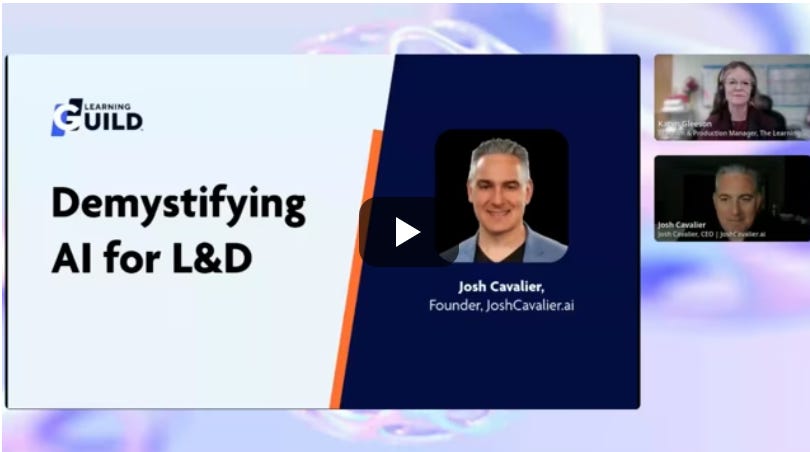
Josh Cavalier’s presentation, Demystifying AI for L&D, discusses how AI actually fits into workplace learning and recommends actionable tools to move from curiosity to action.
Topics:
Why AI matters in L&D and examples of measurable impact.
The Building Blocks of AI (vector embeddings, models, components) and how they power L&D features.
Human–AI Task Scale — a decision tool to map work from human-led to AI-led.
AI Scorecard & CARE principles (Consent, Accuracy, Respect, Equality) to vet tools and vendors.
Practical uses of AI in L&D and prioritized pilots
An “AI Game Plan” and suggested personal development goals (tools, pilot plan, next steps).

📈 News & Trends
Accenture doubles down on AI skills—exit or upskill.
The firm reported $5.1B in gen-AI bookings and is simultaneously exiting employees who can’t reskill while hiring into AI roles.
Why it matters: clients will follow suit—prioritize diagnostics, role redesign, and measurable reskilling pathways over “course catalogs.” Business Insider+1Executives: the bigger risk is not adopting AI.
At Walmart’s 2025 Opportunity Summit, leaders from Walmart, LinkedIn, and OpenAI urged rapid adoption with guardrails.
Why it matters: use this as air cover for pilot approvals tied to workflow KPIs (not seat time). AxiosK-12 signal: AI is the #1 state ed-tech priority (first time).
A new EdWeek/SETDA readout shows AI leapfrogging cybersecurity on state agendas.
Why it matters: standards, PD, and assessment frameworks will ripple into workforce L&D; align nomenclature and evidence models now. Marketbrief+1UNESCO: protect the right to education in the AI era.
During Digital Learning Week 2025, UNESCO released guidance on learner rights, transparency, and accountability in AI-supported learning.
Why it matters: copy-paste into your procurement and design QA checklists (data rights, explainability, human oversight). UNESCO+1Infrastructure tailwind: Equinix launches a global AI Solutions Lab.
Distributed lab sites across 20 locations / 10 countries for enterprise AI experimentation.
Why it matters: lowers friction for running agentic simulations and data-heavy learning analytics during proofs of concept. US English+1Funding watch: AI-native L&D platform raises seed.
Evolve closed $1M to automate course creation, personalize paths, and deliver smart assessments.
Why it matters: validates buyer appetite for creation + personalization + measurement stacks; benchmark your own architecture. AI Insider+1U.S. policy: bipartisan push on AI literacy in schools.
Lawmakers re-introduced the LIFT AI Act to bolster K-12 AI literacy.
Why it matters: common language and frameworks will influence vendor rubrics, credentialing, and public-private upskilling programs. Congressman Gabe Amo
📊 Practice Proven Insights
Recent examples show how AI is reshaping the connection between learning and performance. From reports on career growth to analyses of leadership enablement, these studies highlight what happens when organizations move beyond theory and start measuring how AI changes the way people develop skills, make decisions, and deliver results.
The 2025 LinkedIn Workplace Learning Report argues that AI is the critical driver reshaping the connection between L&D and career growth. The report shows that organizations with mature career development programs are also the frontrunners in adopting AI, using it to build skills faster and create more agile learning paths. This makes it an essential guide for L&D leaders looking to use AI to build a compelling career development strategy.
The Microsoft WorkLab Special Report, "AI at Work is Here. Now Comes the Hard Part," perfectly captured the L&D challenge of fall 2025. It addressed the growing gap between enthusiastic employee adoption of AI and leadership's struggle to see a clear return on investment. The report framed the moment perfectly: the "easy part" of adoption was over, and the "hard part"—redesigning jobs, workflows, and skills—had begun.
This made the report an essential guide for L&D professionals. It showed that their role was now central to solving this "hard part," moving beyond simple tool training to a more strategic function focused on the critical human skills needed to drive real productivity in an AI-powered workplace.
🎙️▶️ Multimedia
Podcasts
Everyday AI Podcast - EP 614: 5 Business Use-Cases for Comet, Perplexity’s agentic browser (September 19, 2025) This episode delves into the new wave of agentic AI browsers, specifically Perplexity’s Comet, and discusses five business use-cases for these tools, which could have significant implications for workflow automation and research within L&D.
Link: Everyday AI Podcast
Elevate Your AIQ - Elevate Your AIQ (September 19, 2025) This podcast series frequently covers the intersection of AI with talent and work, providing valuable insights for L&D professionals looking to understand the broader impact of AI. The September 19th episode focuses on navigating AI hiring risks and mitigating adverse impact, a crucial topic for talent development.
Videos
AI Daily DeepDive 19-Sep-2025 - YouTube Thinks AI Is Its Next Big Bang (September 19, 2025) This video discusses YouTube's significant bet on generative AI for reinventing video creation, discovery, and consumption. This has direct relevance for L&D content creators who rely on video for learning.
The AI Content TRAP: Why I Stopped Making Courses (and You Should Too?) - YouTube AI Learning Communities
James Maduk explains his pivot from creating traditional courses to an "AI recipe" approach, where learners use AI to generate their own content and solutions.
🛠️ Content Creation & Knowledge Tools: Using AI to Build Realistic Learning Scenarios
Creating realistic scenarios is a cornerstone of effective L&D, but it has always been a major bottleneck due to the intense creative effort required. This week, we're focusing on how AI is breaking that bottleneck, making it possible to build everything from the initial narrative to the final interactive practice with unprecedented speed and scale.
To help you navigate this new landscape, here’s a guide that takes you from strategy to practical application.
The Big Picture: Understanding the AI Role-Play Landscape
Before diving into specific tools, it’s helpful to understand the entire ecosystem of AI-powered role-playing tools. A recent guide from ELM Learning provides an excellent overview of the market, explaining how different platforms use AI to simulate realistic conversations and provide data-driven feedback. While focused on sales, its insights are applicable to any soft skills or leadership training.
A Practical Workflow: From Story to Interaction
Once you understand the strategy, you can use specific tools to build your scenarios. Here’s a look at a two-step workflow.
Step 1: Draft the Narrative with an AI Story Generator
The foundation of any great scenario is a compelling story. An article from the AI/ML API Blog explains how AI Story Generators act as powerful co-pilots for L&D. By taking a simple prompt, these tools can instantly generate distinct plots and characters, helping you:
Step 2: Bring the Narrative to Life with Interactive Tools
With a script drafted, the next step is to turn it into a true learning experience using platforms designed for interaction and practice:
Synthesia for AI Avatars: Use this AI video platform to create realistic avatars to act out your scenarios, building visual, role-based interactions without needing actors or cameras.
Rehearsal for AI-Powered Practice: This platform lets you create scenarios for learners to respond to on video. AI then provides feedback on their performance, helping them safely practice and refine their communication skills.
Custom GPTs for Text-Based Role-Play: Build your own specialized chatbots in ChatGPT to serve as conversational partners for practicing skills like negotiation, customer service, or leadership.
Ready to Build? Watch These Tutorials
These tutorials provide a great starting point for seeing these techniques in action.
"How to Use AI to Create Role-Play Scenarios for Your Students" by Harvard Business Publishing: This guide provides a robust, step-by-step process for designing role-play scenarios, from gathering information and defining scenes to providing effective feedback.
Link: Read the Article
"AI Roleplay for Training: Create Realistic Practice Scenarios in Seconds": This video shows you how to use an AI tool to create realistic role-players for leadership and crucial conversations, including how to craft detailed personas and build the AI's "brain."
Link: Watch on YouTube
"Applying Learning through Role-Play | AI for Learning": This video demonstrates how to use a tool like ChatGPT to engage in effective role-playing for learning, including how to ask follow-up questions and capture insights from the interaction.
Link: Watch on YouTube
🤖 LLMs and Learning
1. The Rise of True Multimodality in a Single Prompt
The biggest development this month is the widespread availability of true multimodal input and output within leading models like Google's Gemini 2 and Anthropic's latest Claude release. Previously, you had to use separate tools for text, image, and audio generation.
What's New: Instructional designers can now upload a mixed set of assets—like a PowerPoint slide, a transcript of a SME interview, and a product image—into a single prompt. The AI can understand the context across all formats and generate a cohesive output.
Why It Matters for IDs: This dramatically streamlines the content development workflow. For example, you can now ask an AI to: "Take this slide (image), this speaker's notes (text), and this brand style guide (PDF), and generate a script for a 2-minute explainer video that is visually described and ready for a text-to-voice generator." This collapses multiple steps into one.
2. Generative Video Crosses the Quality Threshold
Generative video tools like Runway and Pika Labs released major updates in September that finally make their output viable for professional L&D content. The key improvements are in character consistency and shot length.
What's New: You can now generate multiple clips (5-10 seconds each) featuring the same AI-generated character, allowing you to string together a coherent narrative. You can also upload a photo of a person (or an AI-generated headshot) to guide the video model.
Why It Matters for IDs: This is a game-changer for scenario-based learning and micro-videos. You can now create custom video scenarios with consistent characters for a fraction of the cost of live-action video. Instead of relying on generic stock footage, you can create a specific clip of "a manager giving constructive feedback" or "a customer asking a challenging question" tailored to your exact needs.
3. AI "Mini-Agents" are Automating Instructional Design Tasks
The concept of AI agents—AI that can perform multi-step tasks—has started to appear in authoring tools and specialized platforms. Instead of a single prompt-and-response, you can give the AI a goal, and it will execute a series of actions to achieve it.
What's New: An ID can now give an AI a high-level command like, "Analyze this 30-page compliance document, identify the top 5 most critical behaviors for employees, and generate a draft of a 10-question knowledge check with feedback for each question."
Why It Matters for IDs: This automates the time-consuming "grunt work" of needs analysis and initial content drafting. It allows instructional designers to spend less time summarizing source material and more time on the high-value strategic work of designing the learning experience, consulting with stakeholders, and focusing on the learner's journey.
4. Easier Fine-Tuning for Hyper-Relevant Content
The process of fine-tuning open-source models (like Meta's Llama 3 or Mistral's latest release) has become much more accessible this month with new, user-friendly tools.
What's New: L&D teams can now, without needing a dedicated data scientist, train a model on their company's own internal documentation—product manuals, support tickets, sales call transcripts, etc.
Why It Matters for IDs: This allows for the creation of incredibly powerful and accurate performance support tools and chatbots. An ID can build a "Product Expert" chatbot that can answer any employee question with perfect accuracy because it's trained only on the company's proprietary information. This moves AI from a general-purpose writing assistant to a true, in-house subject-matter expert.
📚 Applied Research and Working Papers
From “AI helps” to “AI helps when guided.”
Across recent studies, AI feedback reliably lifts mechanics and structure—but gains are uneven without human scaffolding. A 2025 mixed-methods study in Education Sciences found measurable improvements in academic writing with AI assistance, while also flagging risks of over-reliance and shaky content quality—signals that L&D must define when to lean on the model and when to intervene.
Read: Education Sciences (2025) mixed-methods study
Active use beats passive paste.
A large 2024 analysis shows writers who actively revise AI output (edit, reorganize, fact-check) improve lexical sophistication, syntactic complexity, and cohesion; those who accept AI text wholesale see declines. The learning happens in the editing.
Read: arXiv preprint (2024)
Creativity improves—when instructors coach the process.
Evidence from 2025 indicates creativity gains are real when educators guide how AI is used (prompting strategies, iteration, reflection), rather than leaving learners to free-drive the tool. That’s a blueprint for corporate facilitators and faculty alike.
Read: Oregon State University (2025) release
The hidden tax: interaction cost.
Even with good feedback, people struggle to verify AI outputs efficiently. Nielsen Norman Group shows that error-checking often raises interaction cost—more steps, more cognitive load—unless workflows explicitly reduce that burden. Treat verification as a trainable skill and design for it.
Read: AI Chatbots Discourage Error Checking (2025)
🌱 Humanitarian & Nonprofit AI Initiatives
NetHope AI Resource Hub for Nonprofits
A central landing page that organizes NetHope’s AI work for NGOs, including the AI Ethics for Nonprofits Toolkit, the AI Suitability Toolkit, the AI Lighthouse initiative, plus ongoing webinars and field case studies. This is a practical starting point for L&D teams building responsible AI curricula, workshop series, and governance playbooks for humanitarian programs. Start here: Artificial Intelligence NetHopeAI Ethics for Nonprofits Toolkit — frameworks, facilitation assets, and language you can adapt into training and procurement checklists. Open toolkit
AI Suitability Toolkit — a structured way to assess where AI fits (or doesn’t) in NGO workflows; includes workshop guides and decision tools. Open toolkit
AI Lighthouse — program hub guiding nonprofits with practical tools, proven frameworks, and learning content for responsible adoption. Explore
Webinars — recordings and upcoming sessions you can repurpose for staff development. Browse webinars
Case Studies — examples from partners (e.g., HOT’s AI-assisted mapping) to ground training in real humanitarian use. View resources
Why it matters for L&D: The hub consolidates modular curricula, governance-ready language, and field-tested examples—letting you stand up responsible-AI learning pathways without reinventing the wheel. For additional “usefulness” guidance, see NetHope’s companion guides on evaluating AI solutions. Generative AI usefulness guide
Humanitarian Leadership Academy — From AI Literacy to Local Practice
Designed as an applied-learning podcast episode for NGO and L&D leaders, program managers, trainers, and instructional designers, this session moves beyond AI awareness to practical field implementation in low-bandwidth, multilingual, and resource-constrained environments. It surfaces common failure points in headquarters-designed pilots—connectivity limitations, language variability, and limited staffing—and demonstrates how to address them through co-design with local partners, translation of prompts and interfaces, offline-first workflows that maintain continuity during outages, data-minimal practices aligned with safeguarding standards, and micro-learning that supports staff in the flow of work. The result is a repeatable playbook that country programs can adopt without additional headcount or new infrastructure.
💬 Community Spotlight
Here are the key insights from the L&D community since last week:
1. AI's Impact on the Future of L&D Roles
The conversation about how AI will reshape L&D roles is a major topic. The focus is on the need for professionals to adapt by developing new skills and leaning into the human-centric aspects of the job that AI cannot replicate.
Source: LinkedIn's 2025 Workplace Learning Report This report is a foundational piece for this conversation. It directly addresses how organizations with mature career development programs are the same ones leading in AI adoption. It makes the case that AI isn't just a tool, but a force reshaping the connection between L&D, skills, and career growth.
Article: "AI in L&D: 5 Transformative Models" by Donald Clark In this article, thought leader Donald Clark breaks down the specific ways AI is being used to automate tasks like content creation and analysis. This provides a practical look at which parts of the L&D workflow are changing, allowing professionals to see where they need to shift their focus.
2. Integrating L&D with the Broader Talent Ecosystem
The idea of a "skills-based organization" is central to modern L&D strategy. AI is seen as the key technology to finally break down the silos between learning, recruiting, and performance management.
Source: Josh Bersin's Research on Talent Acquisition This recent press release from September 16th details Josh Bersin's latest research on how AI is transforming recruiting. He describes a shift to a "data-driven model" where hiring is more precise. For L&D, this is critical because it means new hires come in with a clearer skills profile, allowing for more targeted and effective onboarding and development.
3. The Renewed Focus on Human-Centered Skills
As AI handles more technical and administrative work, there is a strong counter-movement to double down on skills that are uniquely human. Mentoring and coaching are consistently highlighted as high-value activities for L&D to lead.
Article: "Mentoring Drives Engagement" from the ATD Blog Published on September 17th, this article makes the case that mentoring is a powerful way for experienced employees to guide early-career talent. In an AI-augmented workplace, this kind of human-to-human knowledge transfer and support becomes even more critical for engagement and retention.
4. Practitioner Debates: Timeless Skills vs. Tool Mastery
On the front lines, instructional designers are constantly debating where to focus their professional development. The rise of AI has intensified the discussion about the value of strategic skills versus proficiency with specific software.
Community Discussion: /r/instructionaldesign Subreddit This is the best place to see these conversations happen in real-time. Threads frequently pop up with titles like, "How much do I really need to know about Storyline?" or "Is anyone else feeling like a prompt engineer now?" These discussions provide a direct window into the daily challenges and identity shifts practitioners are navigating.
🗂️ Newsletter Archive
Missed an issue? Explore the full archive of Learning Stacks Weekly:
Learning Stacks Archive — all past newsletters, organized by date.
📤 Share & Subscribe